Ricky


ControlLogix Indirect Addressing 2

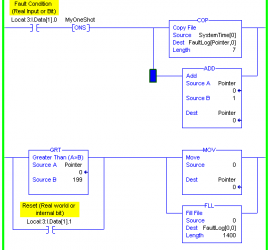
Introduction to ControlLogix Indirect Addressing ControlLogix Indirect Addressing allows you to have a variable address.   This is an address that changes on the fly.   Imagine a tank farm with 28 tanks.   We would have the exact same logic for each tank, but a different address to access Read More »
Fault Logic

ControlLogix Add-On Instructions

Introduction to ControlLogix Add-On Instructions ControlLogix Add-On Instructions allow you to create your own instructions.  Whenever you feel that you are writing the same logic over and over again, there is usually a better way of doing things.   For example:   You can also use add-on instructions for motor control Read More »

Use Add-Ons

ControlLogix Forcing and Associated Dangers

Introduction to ControlLogix Forcing and Associated Dangers In this section, we’ll discuss ControlLogix Forcing and Associated Dangers. ControlLogix Forcing simulates real world jumpers to some extent.   Forcing works on real world inputs or real world outputs.   You can also for aliases to real world inputs or real world Read More »

Output Jumper

Assigning IP Address with RSLinx 1

Introduction to Assigning IP Address with RSLinx (Static IP) There are two common ways to assign an IP address to an Ethernet module in the ControlLogix chassis:  BootP, or RSWho.  A third way of assigning an IP address only works if you are using the subnet of 192.168.1.x.   On newer modules, Read More »

Port Configuration

ControlLogix Online Editing 2

Introduction to ControlLogix Online Editing ControlLogix Online Editing allows you to make changes on the fly.  This means that you do not have to drop offline to make your changes, then download to your processor.   When you download, your processor must go to program mode to accept the download. Read More »

Online Edit Featured

ControlLogix UDTs

Introduction to ControlLogix UDTs ControlLogix UDTs are User Defined Data Types.   User Defined Data Types allow us to create a data structure for a particular part of our system.   We can then use that data structure throughout our project.    Examples of where we might use a UDT Read More »

Mapping

ControlLogix GSV Command (Battery Low)

Introduction to ControlLogix GSV Command (Battery Low) In this post, we will discuss how to use the ControlLogix GSV Command to find the Battery Low bit in the system.   Older processors, such as the L6x and earlier used a battery in the default configuration.  A battery option is also available on Read More »

Battery Not Low

ControlLogix GSV Command (WallClockTime) 11

Intdoduction to ControlLogix GSV Command (WallClockTime) In this post, we will discuss the ControlLogix GSV Command (WallClockTime).  Earlier processors, such as the SLC-500 and PLC-5 had a data file dedicated to system status (S2).   In the S2 file, you could find the data table addresses of system information such as the Read More »

Set Date Time

ControlLogix Compare Instructions

Introduction to ControlLogix Compare Instructions ControlLogix Compare Instructions are generally used with analog values to determine if a tag is above, below, or within a preset range.   Examples of where a compare instruction might be used is if a tank level exceeds a certain preset.  Also, if a sump Read More »

Less than Greater than

ControlLogix Analog 3

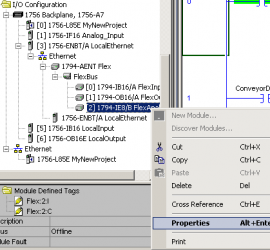
Introduction to ControlLogix Analog Discrete (digital) inputs and outputs are signals that are on or off.   There is no middle state to discrete.  These were good for switches, indicator lights, or motor starters, but if we want to measure a variable signal, we need an analog module.     Read More »

IE8 Properties